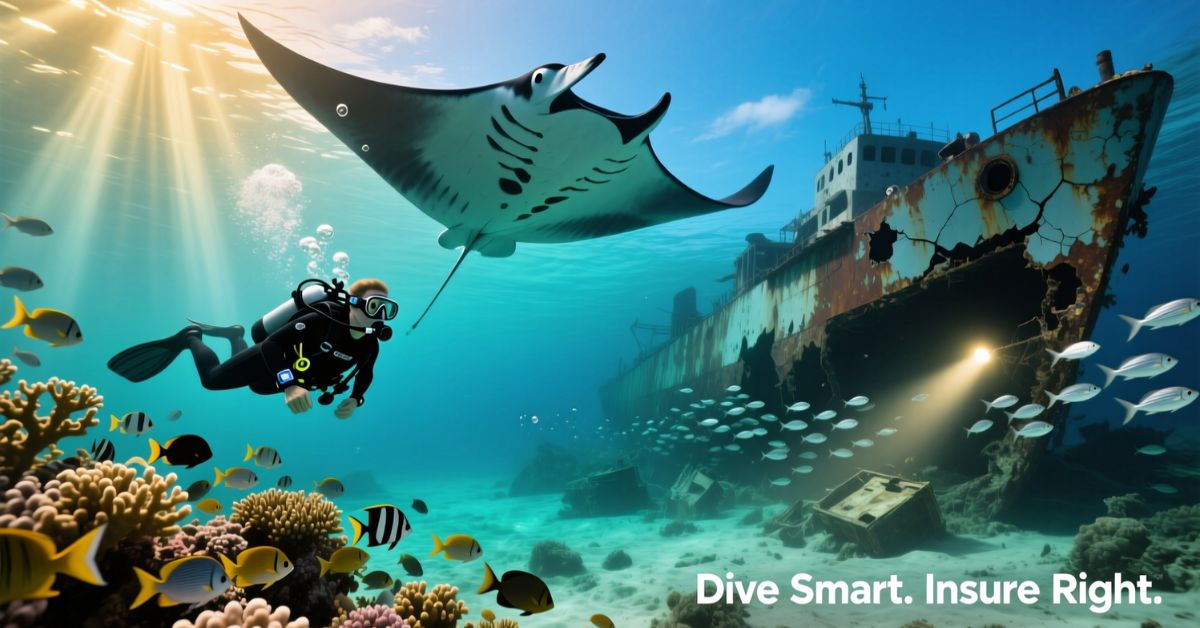
The idea of a dive trip must feel thrilling, whether it’s drift dives in Cozumel and manta Rays in the Maldives and wrecks at Truk Lagoon. But before you get off the boat, you should be aware of something that divers often overlook: travel insurance for diving. Conventional travel policies usually don’t cover activities that require a license and leave divers vulnerable to costly medical bills emergency evacuations, as well as delays in their travel plans.
This guide will explain what divers should consider when choosing the policy, ways to stay clear of common coverage gaps and what add-ons are important the most. If you’re a novice diver or a veteran traveler seeking certification, this guide will help you choose the best cover for your next dive.
Why Specialized Travel Insurance Matters for Scuba Divers
The majority of travelers assume that their normal travel insurance will cover diving. However, many policies categorize diving as an “high-risk activity” that is to say:
- Limitations on depth that nullify claims
- No insurance coverage for air evacuation following an accident at the dive
- Exclusions from liveaboard excursions or remote dive destinations
- There is no reimbursement for lost dive days due an illness or equipment failure
In actual situations, the treatment of decompression sickness (DCS) can cost more than $10,000 to $20,000. particularly if several chamber sessions are needed. In addition, evacuation from an isolated island, and the costs could be astronomical.
A specific travel insurance policy for diving policy makes sure that such situations do not ruin your vacation or your budget.
Key Coverage Features Divers Should Look For
1. Emergency Medical Coverage (Including Dive Accidents)
Check for a policy which includes:
- Treatment in the hyperbaric chamber
- Insurance coverage for decompression illness barotrauma, nitrogen narcosis, and barotrauma and marine life injury
- There is no depth limit, or at minimum, the depth is in line to your certification level
A tip for you: Some insurers require the proof of certification (PADI or SSI NAUI). Keep digital copies of your travel documents.
2. Emergency Evacuation & Repatriation
Diver emergencies are rare to occur next to a fully-equipped hospital. Your policy should contain:
- Boat or air evacuations from dive sites that are remote
- Transfer coverage to the nearest medical facility
- Repatriation back to your home country following treatment
It is among the most crucial parts for divers and, usually the most expensive in the event of an emergency.
3. Trip Cancellation & Interruption Benefits
Dive trips involve prepaid expenses–liveaboards, charters, gear rental, certification courses. Make sure you have insurance that will reimburse you in the event you have to cancel your trip because of:
- Injury or illness
- Family emergency
- Natural disasters or severe weather
- Dive operator bankruptcy
A secondary keyword that naturally is included is diving trip coverage.
4. Gear Protection (Loss, Theft, or Damage)
Scuba gear is expensive. A good insurance plan will protect:
- The underwater camera and housing
- Computers that dive
- Regulators and BCDs
- Exposure is a good idea
Make sure you check the the limits per item, and think about the listing of high-value camera systems separately.
5. Liveaboard & Remote Destination Coverage
Some policies do not automatically will cover:
- Liveaboards not connected to the liveaboards.
- Changes to the itinerary due to the weather
- The delay is caused by bags that are lost that contain essential dive equipment
If you’re planning to visit the Galapagos or Raja Ampat Socorro or any other remote area, make sure you read these rules carefully.
Types of Policies Divers Commonly Use
Standard Travel Insurance with Adventure Add-On
Ideal for recreational divers who are casual and that stay within the limits of basic depth (often between 18 and 30 meters).
Pros:
- Affordable
- Simple to purchase when you have your existing travel plan
Cons:
- The coverage limits could be lower
- Depth restrictions may void claims
Specialized Scuba Diving Travel Insurance
Made specifically for divers, the scuba gear includes the latest medical evacuation, dive gear protections.
Pros:
- Complete diving-specific coverage
- Often includes 24/7 dive emergency hotlines
- More exclusions
Cons:
- A little more expensive, but usually is worth it for peace mind
Annual Multi-Trip Policies
Great for frequent travellers or divers who have completed several trips or levels of certification within a calendar year.
Pros:
- Cost-effective
- Always present
- Covers spontaneous dive trips
Cons:
- Check the limits of activity and depth
Common Exclusions Divers Should Watch Out For
A lot of divers find exclusions only after filing an claim. Be sure to read your policy attentively to:
- Doing solo diving with no proper training
- Technical diving (trimix cave, trimix or rebreather usage)
- Wreck penetration
- Divers who are not certified by a professional is not recommended.
- Diving beyond your certification depth
- Divers who are not certified
If you’re planning a dive that is more challenging think about a firm which can help you with expedition or technical dives.
How to Choose the Best Travel Insurance for Your Diving Trip
Check this basic checklist before buying a insurance policy:
Confirm evacuation and medical coverage that includes diving accidents
This should be a non-negotiable requirement.
Be on the lookout to find “certified divers” phrase.
This will ensure that your coverage is in line with the training you have completed.
Check depth limits
Find them in your plan dives, especially if you are doing deep diving as well as advanced dive certifications.
Compare the amount of coverage.
Higher is more suitable for diving, particularly when diving overseas.
Camera equipment and review gear limit the capabilities of review gear and camera equipment.
Underwater cameras typically require additional coverage.
Make sure that liveaboard coverage is provided
Find out if missed departure coverage is applicable in the event of delays to flights.
Real customer reviews from real customers.
Seek out those that make mention of diving-related claims that have been proven to be successful.
Real Example: Why Having Dive Coverage Matters
In a liveaboard excursion within the Red Sea, a diver felt symptoms of DCS after a long dive. The vessel organized an emergency evacuation via speedboat, which was followed by air transportation to a hyperbaric center. The total cost was more than the amount of $17,000.
As the diver had an exclusive diving policy and the insurer was able to cover medical care, evacuation and even reimbursed the non-used portion of the liveaboard.
Without insurance, this could be a financial disaster.
Conclusion: Safe Diving Starts Before You Hit the Water
A successful dive experience is a result of preparation and insurance for travel and diving is an essential part of the foundation. When you’re exploring coral reefs, or perhaps planning an unforgettable liveaboard, obtaining the appropriate policy will ensure you’re covered from injuries, medical emergencies, equipment loss, weather-related disruptions and many more.
When you’re planning your next dive trip take the time to review your options ensure that you are covered according to your diving certification and style Make sure you’re protected where it matters most – both above and below the surface.
FAQ’s
1. Does your travel insurance policy provide coverage for diving?
Often no. Most standard policies limit or prohibit diving, unless you buy any water or adventure sports accessory.
2. Do I require special insurance for technical or deep diving?
Yes. Cave diving, technical diving, and deeper depths typically require specialization.
3. Will my policy cover a dive accident if I exceed my certification depth?
In general, there is not. The claim may be denied when you go over the your depth limit or dive in a dangerous manner.
4. Does travel insurance cover dive gear?
Certain insurance policies cover theft, loss or damage, but the limits can vary, especially for cameras.
Disclaimer :
The content on Gap Insurance Guide is for informational and educational purposes only and is not legal, financial, or insurance advice. While we strive for accuracy and reference trusted sources and news websites, we make no guarantees about the completeness or reliability of the information. Insurance laws and policies vary by state, and individual circumstances differ. Always consult a licensed professional before making decisions. By using this site, you agree that Gap Insurance Guide is not responsible for any actions taken based on this content.